Welcome to WordPress. This is your first post. Edit or delete it, then start writing!
Blog
-
Cameras That See in the Dark: Turning Night into Day with Modern Low-Light CCTV
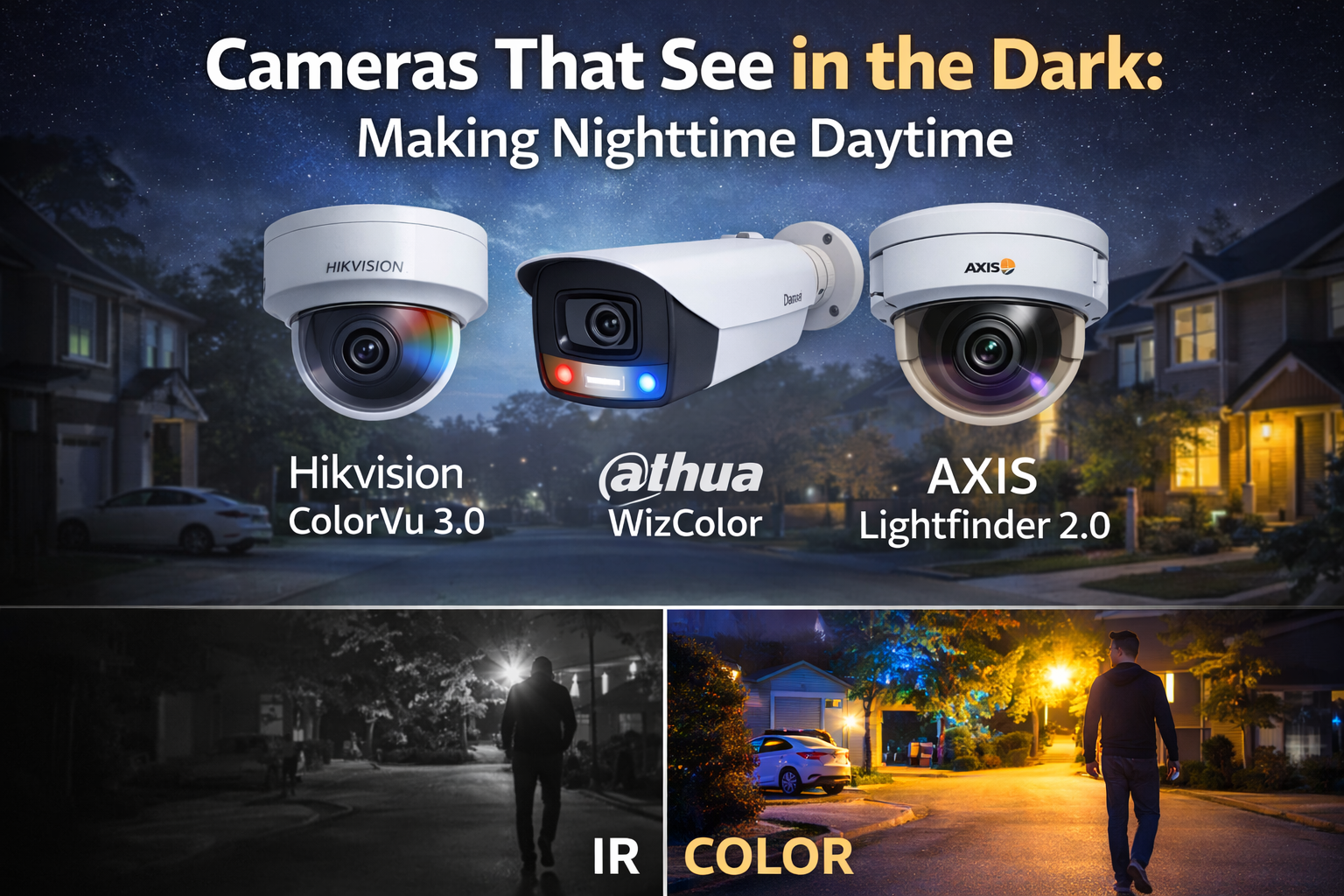
For years, night-time security footage meant grainy black-and-white images with limited detail. Today, that has changed dramatically. Thanks to advanced low-light sensor technology, AI image processing, and ultra-wide apertures, modern cameras can deliver full-colour video at night, often with little to no visible lighting.
This article explains how night-vision has evolved, why “colour at night” matters, and how leading technologies from Hikvision, Dahua, and AXIS are redefining after-dark surveillance.
Why traditional night vision falls short
Conventional CCTV relies on infrared (IR) LEDs once light levels drop. While IR is effective for detection, it has limitations:
-
Black-and-white images only
-
Loss of key identifying details (clothing colour, vehicle colour)
-
Overexposed faces at close range
-
Large image sensors (capture more light per pixel)
-
Ultra-wide aperture lenses (let in more light)
-
Advanced noise reduction (AI-driven, not aggressive blurring)
-
Smart colour processing (maintains colour accuracy in darkness)
-
Optional soft white light (only when needed)
-
Super-large sensors with enhanced light sensitivity
-
Fixed or hybrid white-light illumination (not harsh spotlights)
-
AI image optimisation to reduce noise while keeping detail
-
Residential streets and driveways
-
Strata car parks and building perimeters
-
Retail storefronts and entrances
-
High-performance CMOS sensors
-
Advanced colour-retention algorithms
-
Reduced reliance on IR or white light
-
Large open areas (warehouses, yards)
-
Sites where visible lights are undesirable
-
Commercial and industrial locations
-
Industry-leading image processing
-
Natural colours with minimal motion blur
-
Exceptional performance in mixed lighting (headlights, shadows, glare)
-
High-end commercial sites
-
Transport, infrastructure, and critical facilities
-
Environments where image accuracy is critical
-
Low ambient light + residential/strata → Hikvision ColorVu
-
Large dark areas + minimal visible light → Dahua WizColor
Limited usefulness for investigations and evidence
Modern low-light cameras aim to capture more visible light instead of switching to IR, producing clearer, more natural images.
How modern cameras make night look like day
Today’s “see in the dark” cameras combine several key technologies:
The result: usable, colour-accurate video in extremely low lux environments.
Hikvision – ColorVu 3.0
Hikvision’s ColorVu 3.0 technology is designed specifically for 24/7 colour imaging, even in near-dark conditions.
What makes ColorVu different
Best suited for
ColorVu is especially effective where ambient light exists (streetlights, nearby buildings), delivering colour images where older cameras would already be in black-and-white.
Dahua – WizColor
Dahua’s WizColor technology focuses on accurate colour reproduction in ultra-low-light scenes, even without additional lighting.
Key strengths
Best suited for
WizColor cameras excel in environments where you want discreet surveillance but still need clear colour detail at night.
Axis Communications – Lightfinder 2.0
AXIS has long been regarded as a leader in image quality, and Lightfinder 2.0 represents their most advanced low-light technology to date.
What sets Lightfinder 2.0 apart
Best suited for
Lightfinder 2.0 prioritises true-to-life colour and contrast, making it ideal for evidentiary-grade footage.
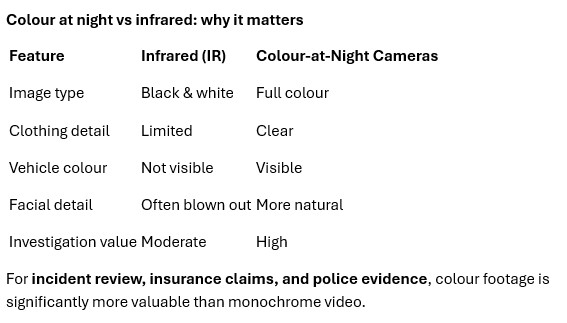
Colour at night vs infrared: why it matters
For incident review, insurance claims, and police evidence, colour footage is significantly more valuable than monochrome video.
Choosing the right night camera for your site
There is no single “best” night camera — it depends on the environment:
Critical detail + premium image quality → AXIS Lightfinder 2.0
The most important factor is proper design: lens choice, mounting height, field of view, and lighting conditions all matter more than marketing terms alone.
-
-
Home Security Explained: Alarms, CCTV & Practical Tips to Protect Your Home
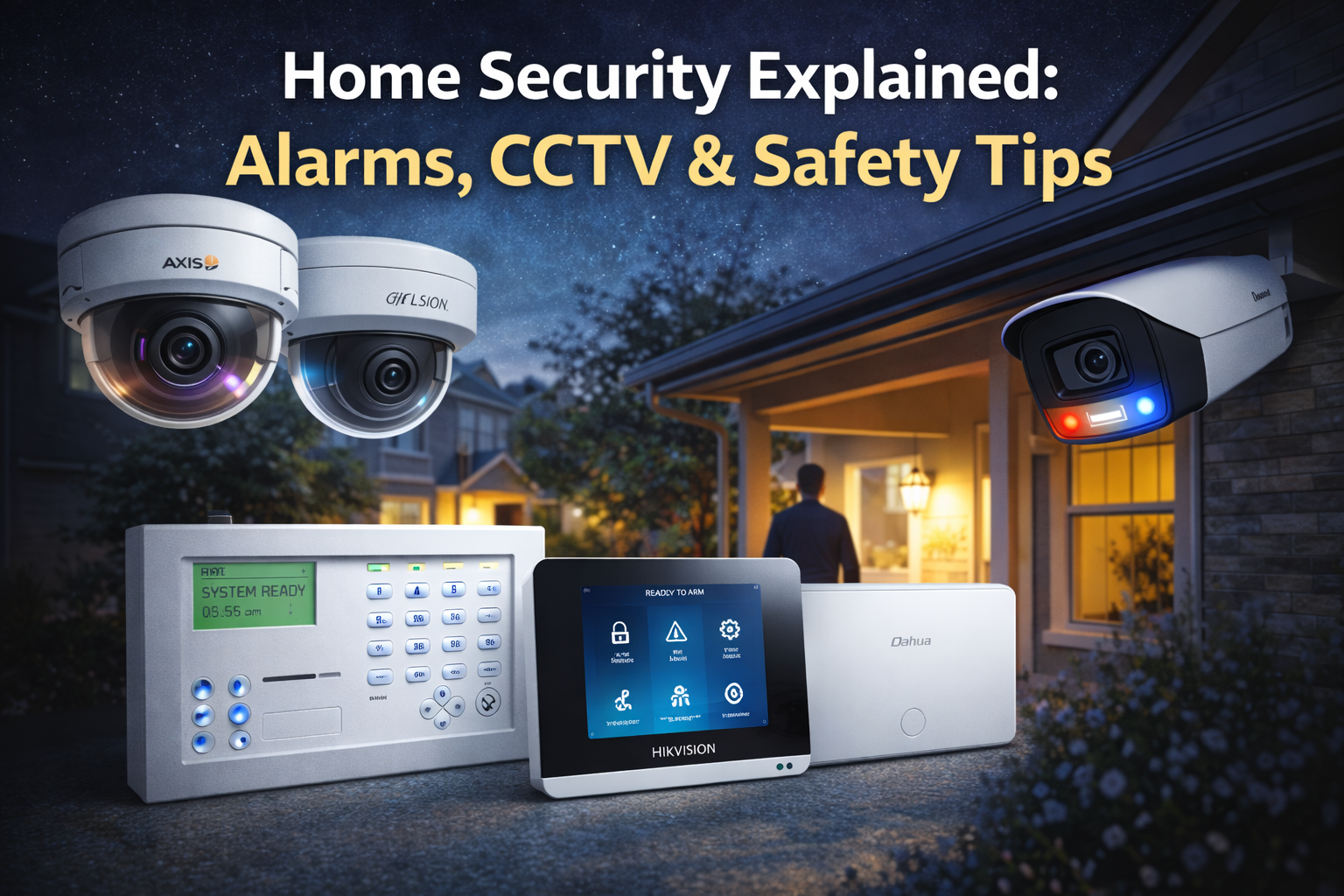
This guide explains the key components of a modern home security setup — alarm panels, CCTV systems, and practical tips — with real-world examples using trusted platforms such as Reliance, Hikvision, Dahua, and AXIS Communications.
1. Alarm Panels: Your First Line of Defence
An alarm system is designed to detect intrusion early and alert you before a situation escalates. When correctly installed and configured, alarm panels provide immediate feedback and deterrence.
🔐 Reliance Alarm Panels
Reliance alarm systems are widely used in Australia and are known for their reliability, simplicity, and compliance with local standards.
Why homeowners choose Reliance
-
Proven, stable hardware
-
Wired and wireless options
-
Suitable for professional monitoring
-
Smart phone notifications
-
Wireless PIRs, door sensors, and keypads
-
Easy integration with CCTV and intercoms
-
Clean, modern app interface
-
Reliable wireless devices
-
Good integration with Dahua CCTV
-
Strong value for money
-
Exceptional low-light performance
-
Accurate colour and detail
-
Strong cybersecurity design
-
Long product life and firmware support
-
Colour-at-night cameras
-
Active deterrence (lights and audio warnings)
-
Smart human/vehicle detection
-
Excellent value across multiple budgets
-
Alarm triggers to bring cameras up instantly
-
Visual verification before responding
-
Reduced false alarms
-
Faster, more informed decisions
-
A door sensor activates → camera recording starts
-
A motion detector triggers → you receive live video
-
An alert sounds → visible deterrence discourages intruders
-
Install cameras at realistic heights (not too high to identify faces)
-
Use visible cameras at entry points — visibility alone deters crime
-
Keep side gates locked and well-lit
-
Reinforce door frames, not just locks
-
Use sensors on sliding doors and rear windows
-
Use motion-activated lighting near entrances
-
Avoid harsh lighting that causes glare into cameras
-
Consistent low-level lighting improves camera performance
-
Keep apps and firmware updated
-
Use strong passwords and two-factor authentication
-
Don’t overshare holiday plans on social media
-
Property size and layout
-
Entry points and blind spots
-
Desired level of automation
-
Budget vs long-term reliability
Ideal for homeowners wanting a robust, no-nonsense alarm system
📱 Hikvision Alarm Systems
Hikvision alarm panels integrate tightly with their CCTV ecosystem, offering a single app experience for alarms and cameras.
Key benefits
Ideal for tech-savvy households
🚨 Dahua Alarm Systems
Dahua alarm platforms focus on ease of use and scalability, making them popular for homes that may expand their security later.
Strengths
2. CCTV Systems: Seeing What’s Really Happening
While alarms alert you to a problem, CCTV shows you what actually happened — and often helps prevent incidents altogether.
🎥 Axis Communications CCTV
AXIS is regarded as a leader in image quality, reliability, and cybersecurity. Their cameras are commonly used in high-end residential and commercial sites.
Why AXIS stands out
Ideal for homeowners who want premium quality and long-term reliability.
🎥 Hikvision & Dahua CCTV for Homes
Both Hikvision and Dahua offer a wide range of residential-friendly cameras, including:
These systems are particularly effective for driveways, side access, backyards, and street-facing cameras.
3. Combining Alarms and CCTV = Smarter Security
The most effective home security setups combine alarm panels with CCTV, allowing:
For example:
4. Practical Home Security Tips (Often Overlooked)
Technology works best when combined with good security habits:
🏠 Exterior tips
🚪 Doors & windows
Secure garages — they are a common weak point
💡 Lighting
📱 Smart habits
5. Choosing the Right System for Your Home
There is no “one-size-fits-all” home security system. The right choice depends on:
A small home may only need a compact alarm and 2–3 cameras, while larger properties benefit from layered coverage and smart integration.
Final Thoughts
Modern home security is about prevention, visibility, and fast awareness — not just reacting after the fact. By combining a reliable alarm panel with quality CCTV and smart design choices, homeowners can significantly reduce risk and gain real peace of mind.
-
-
Megapixels in Security Cameras: What’s the Real Difference Between 2MP, 4MP, 6MP and 8MP?
When people compare security cameras, the first thing they often look at is megapixels (MP). More megapixels can mean more detail — but only when the camera, lens, lighting and scene are matched correctly.
This guide breaks down what you actually get from 2MP, 4MP, 6MP and 8MP, how they impact identification, storage, and low-light performance, and how the major brands AXIS Communications, Dahua, and Hikvision support each resolution tier.
What a “megapixel” really means (and why it’s not the whole story)
A megapixel is simply one million pixels. More pixels can allow:
-
More detail on the same scene (better zoom-in after the fact), or
-
Sensor size and sensitivity (low light)
-
Lens quality and field of view
-
Dynamic range (WDR) for backlit scenes
-
Compression settings and bitrate
-
Lobbies, hallways, small offices
-
Situations where you’ll mount the camera closer to the subject
-
Projects prioritising low storage and stable streaming
-
Lower bandwidth + storage compared with higher MP
-
Often strong low-light performance when paired with a good sensor/lens
-
Great value and easy to deploy at scale
-
Less ability to digitally zoom in and still retain detail
-
Wide-angle scenes may not deliver enough detail at a distance
-
AXIS offers many 2MP models (e.g., AXIS M3085-V is 1920×1080).
-
Dahua WizSense 2MP models commonly output 1920×1080.
-
Strata common areas, car parks, and loading docks
-
Retail floors where you want extra facial/incident detail
-
Noticeably more detail than 2MP for the same view
-
Often a strong balance of cost, storage, and clarity
-
More storage and bandwidth than 2MP
-
If you push very wide angles, you can still run into pixel-density limits
-
AXIS M3106-LVE Mk II lists 2688×1520 max video resolution.
-
Dahua IPC-HFW2449T-AS-IL lists 4MP (2688×1520).
-
Larger areas where you still need identifiable detail
-
Sites that want clearer images for incident review (without the full overhead of 8MP)
-
Multi-use scenes (people + vehicles) where you may need to crop in
-
Strong step-up for zooming/cropping footage
-
Useful when you can’t mount closer but still need detail
-
Higher bandwidth/storage
-
Can require better lighting and a correct lens choice to avoid motion blur
-
AXIS supports 6MP in various cameras (e.g., AXIS M3067-P is 3072×2048).
-
Dahua 6MP WizSense models commonly output 3072×2048.
-
Large open areas: car parks, warehouses, perimeter lines
-
Scenarios where you expect to zoom in during investigations
-
When you want to cover a wider scene without sacrificing as much detail
-
Highest ability to crop in and still keep detail
-
Great for scenes where subjects may be further from the camera
-
Significantly higher storage and bandwidth requirements
-
Needs good lighting and correct settings to avoid blur/noise
-
Poor design choices (wrong lens/placement) can waste the extra pixels
-
AXIS P1388 promotes 8MP with “excellent image quality in 4K”.
-
Dahua 8MP models list 3840×2160 output.
-
Detect: Is someone there?
-
Observe: What are they doing?
-
Recognise: Is it the same person you’ve seen before?
-
Identify: Can you clearly identify them?
-
Choose 2MP when cameras are close to the subject and you want efficient storage (corridors, small rooms, entrances).
-
Choose 4MP for the best all-round balance in most strata/commercial jobs.
-
Choose 6MP when you need better zoom-in detail across mid-to-large scenes.
-
Choose 8MP (4K) when the scene is big and you’re prepared to design around bandwidth, lighting, lens choice, and recording capacity.
Wider coverage while maintaining usable detail.
But megapixels don’t automatically guarantee better results, because image quality also depends heavily on:
Motion blur (shutter settings, lighting)
So think of megapixels as potential detail, not a guaranteed outcome.
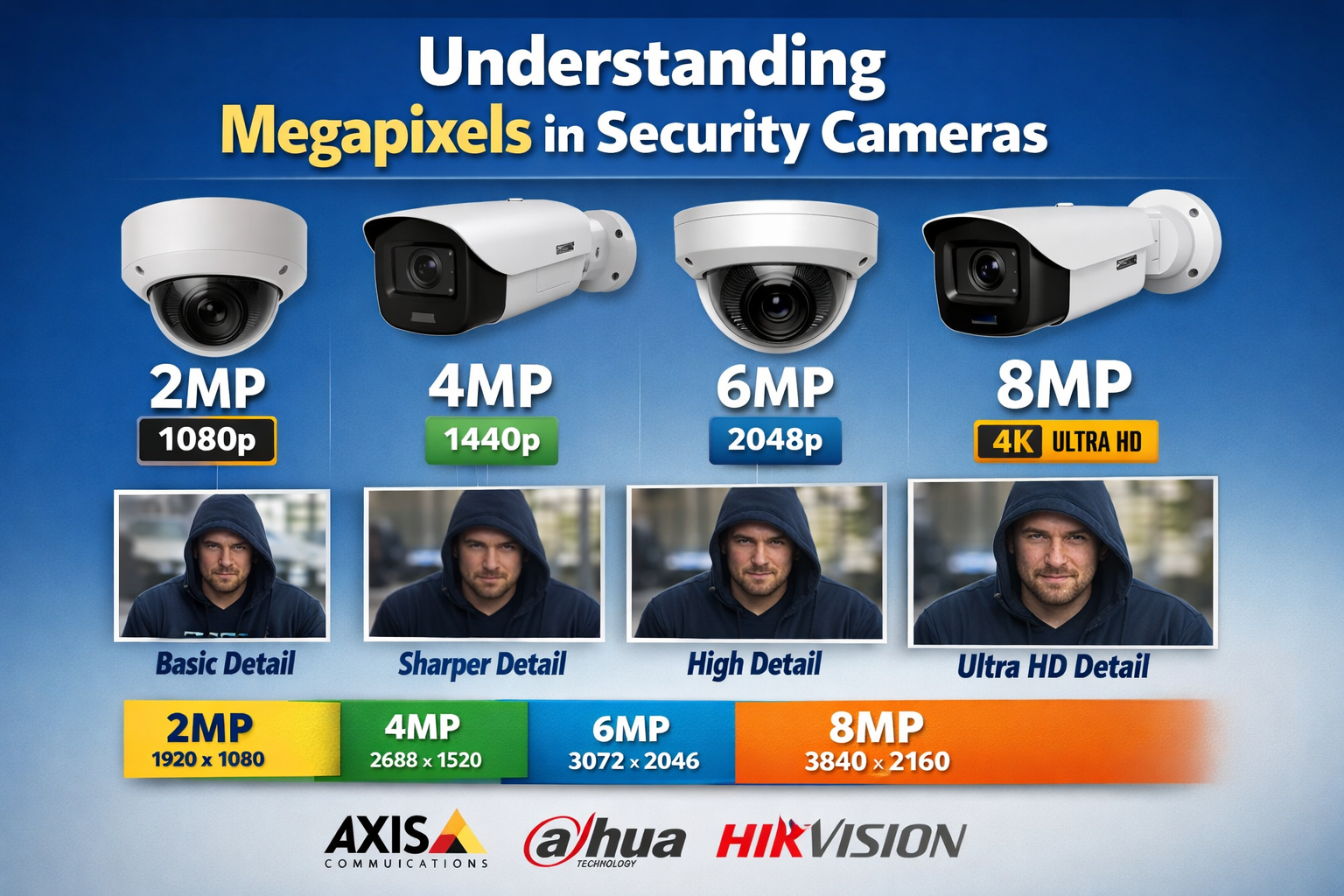
Resolution cheat sheet (with real-world camera examples from major brands)
Below are the most common “real” pixel dimensions used in security cameras for each megapixel tier (as shown in manufacturer specs).
TierTypical max resolutionPixels per frame (calculation)What it’s commonly called
2MP 1920 × 10801,920 × 1,080 = 2,073,600 (~2.07MP)1080p / Full HD4MP2688 × 15202,688 × 1,520 = 4,085,760 (~4.09MP)“4MP”
6MP3072 × 20483,072 × 2,048 = 6,291,456 (~6.29MP)“6MP”8MP3840 × 21603,840 × 2,160 = 8,294,400 (~8.29MP)4K / UHDProof these are common in real products:
2MP (1920×1080): AXIS M3085-V max video resolution 1920×1080 ; Dahua IPC-HFW2241T-ZS outputs 2MP (1920×1080) ; Hikvision DS-2CD2123G0-I(S) max resolution 1920×10804MP (2688×1520): AXIS M3106-LVE Mk II max video resolution 2688×1520 ; Dahua IPC-HFW2449T-AS-IL outputs 4MP (2688×1520) ; Hikvision DS-2CD2345G0P-I max resolution 2688×15206MP (3072×2048): AXIS M3067-P datasheet lists 6MP (3072×2048) ; Dahua DH-IPC-HDW3666EMP-S-AUS outputs 6MP (3072×2048) ; Hikvision DS-2CD2365G1-I max resolution 3072×20488MP / 4K (3840×2160): AXIS P1388 highlights 8MP / 4K ; Dahua IPC-HDW3849H-AS-PV-ANZ-S2 outputs 8MP (3840×2160) ; Hikvision DS-2CD2386G2-I(U) max resolution 3840×2160
2MP (1080p): the “workhorse” for general coverage
Best for:
Pros
Cons
Brand examples
Hikvision Pro-series 2MP cameras list 1920×1080 max resolution.
4MP: the “sweet spot” for sharper detail without going full 4K
Best for:
Wider scenes where 2MP starts to look soft when zoomed
Pros
Cons
Brand examples
Hikvision DS-2CD2345G0P-I lists 2688×1520 max resolution.
6MP: where detail starts to become “investigation-friendly”
Best for:
Pros
Cons
Brand examples
Hikvision 6MP models list 3072×2048 max resolution.
8MP (4K): maximum detail — when you can support the bandwidth and lighting
Best for:
Pros
Cons
Brand examples
Hikvision 8MP AcuSense turret shows max resolution 3840×2160.
The biggest mistake: choosing megapixels before you choose the outcome
The right question isn’t “How many megapixels?” — it’s:
What do you need the footage to do?
These are commonly referred to as DORI, and manufacturers like AXIS publish planning guidance that ties required detail to pixel density and operational outcomes. Also worth noting: AXIS has discussed how the IEC 62676-4 standard is evolving beyond the familiar DORI framework (with updates described in late 2025), reinforcing that performance planning is more than just “MP”.
Practical recommendations (simple, real-world)
-
-
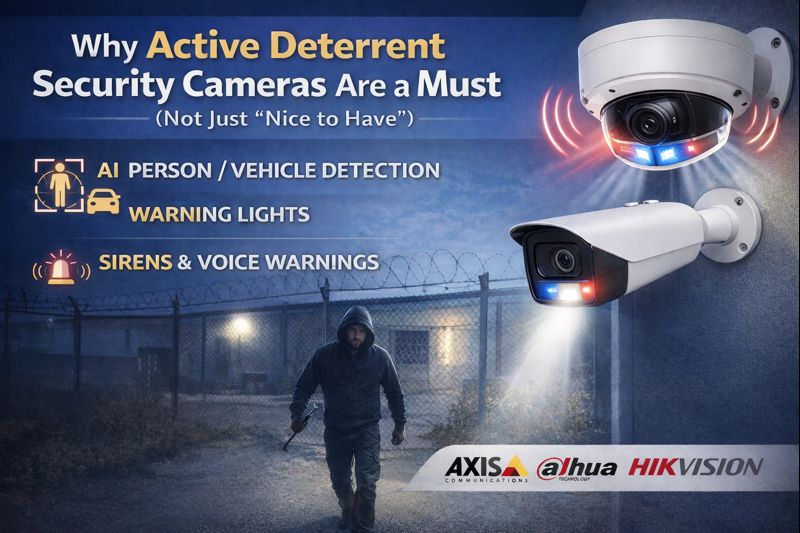
Why Active Deterrent Security Cameras Are a Must (Not Just “Nice to Have”)
Traditional CCTV is great at recording what happened. But when you’re trying to stop incidents — break-ins, trespass, vandalism, after-hours loitering — recording alone is often too late.
That’s where active deterrent security cameras come in. They combine smart detection (human/vehicle classification) with immediate, attention-grabbing responses such as strobe lights, sirens, and voice warnings. The goal is simple: interrupt the behaviour before the crime happens.
Below is what the research says about deterrence, why “active” responses matter, and how the major brands (AXIS, Dahua, Hikvision) approach it.
1) The research: CCTV can reduce crime — but results depend heavily on how it’s used
A major, widely cited systematic review and meta-analysis (covering 80 evaluations) found CCTV is associated with a statistically significant, but generally modest reduction in crime, with the strongest and most consistent results in certain environments.
Key findings from that meta-analysis:
-
Car parks: crime reduced by ~37% in treatment areas vs control areas (pooled result).
-
Residential areas: also showed a statistically significant reduction (smaller than car parks, but still significant in the pooled results).
-
Crime types: significant reductions were seen for vehicle crime and property crime, while effects were not significant for violent crime in the pooled results.
Crucially, the same review notes that in many of the strongest-performing “car park” schemes, CCTV wasn’t acting alone — they often included other measures (like improved lighting, signage, security guards) and many were actively monitored.
That’s the bridge to active deterrence: the more “certain” the detection and response feels, the more deterrent power you typically get — not just a silent recording device.
2) Passive cameras vs active deterrence: why “doing something” changes outcomes
Some public discussions point out that the evidence for cameras deterring crime (especially in individual homes) can be mixed, and that context matters.
So what improves outcomes?
Fast intervention + clarity that you’ve been detected
Australian Institute of Criminology research on CCTV and investigations in NSW’s rail network found that when CCTV footage was requested/provided, it was associated with higher clearance rates (solving matters), and also notes evidence that incidents detected via actively monitored CCTV can be more likely to lead to arrest compared to public reporting.
Active deterrence is essentially bringing that “active” element closer to the camera itself:
-
Detect a person/vehicle in a defined zone
-
Respond immediately with light/sound/voice
-
Notify security/owners (and optionally escalate)
This isn’t a guarantee of prevention — but it materially improves the odds that an opportunistic offender decides it’s not worth it.
3) What “active deterrence” actually is (and what it isn’t)
An active deterrent camera (or system) typically includes:
-
AI-triggered detection (ideally human/vehicle classification to reduce false alarms)
-
Light (white strobe, spotlight, or coloured warning lights)
-
Audio (siren and/or pre-recorded voice messages; sometimes live talk-down)
-
Larger sites (commercial/industrial/strata) needing VMS integration, zoning, and scalable alerting workflows
-
Scenarios where you want separate but coordinated camera + warning device placement (e.g., sound projected where it matters most)
-
Sites wanting a single-device deterrence option (camera + light + audio)
-
Applications where visual warning (including coloured lights in some models/lines) is a strong fit for the environment
-
Strong value for AI detection + deterrence in a single unit
-
Response time matters (after-hours sites, car parks, loading docks)
-
You need to stop vandalism and opportunistic theft (property/vehicle-related crime aligns with where CCTV shows stronger effects in research)
-
You have repeat nuisance issues (dumping, trespass, loitering)
Mobile alerts + integration with VMS/monitoring workflows
Dahua describes active deterrence as using built-in spotlight and speaker to deter intruders “in time” and prevent potential crime, with AI-assisted accuracy. Hikvision’s Live Guard positioning similarly centres on a camera with speaker + strobe light that can activate when a person/vehicle is detected.
4) Brand approaches: AXIS, Dahua, Hikvision
AXIS: flexible, best-in-class integration (camera + audio/visual warning devices)
AXIS is often deployed in professional environments where you want tight control over what happens when an event occurs. A good example is AXIS’s network strobe speaker approach: the AXIS D4200-VE is designed to issue warnings and deliver information using custom messages and strobe lights, supporting automated responses.
Where AXIS tends to shine
Dahua: TiOC + Active Deterrence as a “built-in” all-in-one package
Dahua’s TiOC (Three-in-One Camera) family is specifically designed around proactive prevention — not just recording. Dahua’s TiOC 2.0 materials describe siren + light behaviour for deterrence, including switching illumination modes and triggering alarms when rule areas are breached. Dahua also describes “Active Deterrence” as preventing crime via built-in spotlight and speaker, with AI-focused intrusion alarms and app notifications.
Where Dahua tends to shine
Hikvision: Live Guard + AcuSense models with strobe + audio
Hikvision’s Live Guard positioning is very direct: a camera with an in-built speaker, selectable voice warning/siren, and strobe light that activates on person/vehicle detection. Hikvision also documents that select AcuSense models offer built-in sirens and strobe-light alarms, and can broadcast custom voice messages to warn trespassers.
Where Hikvision tends to shine
Common use cases in residential, small business, and strata where quick deterrence features deliver practical benefit
5) When active deterrence is most worth it (real-world use cases)
Active deterrent cameras are especially useful when:
You want fewer false alarms and better actionability (human/vehicle classification vs generic motion)
6) How to deploy active deterrence properly (so it helps, not annoys)
Active deterrence works best when it’s configured thoughtfully:
Use AI-based triggers (human/vehicle), not basic motionThis reduces nuisance activations (trees, shadows, insects).Deterrence should be “graduated”Start with a voice message (“This area is monitored…”) before escalating to siren/strobe, depending on time of day and risk.Add signage and good lighting designResearch suggests CCTV often performs best when paired with other situational measures like lighting and signage, especially in high-performing settings.Have a plan for escalationNotifications, guard response, or monitored workflows matter — “active” isn’t just the camera, it’s the operational response around it. (This aligns with the broader evidence that active monitoring and timely access can improve outcomes.)Respect privacy and noise considerationsIn Australia, you should ensure deployments align with privacy expectations and that any audible warnings are appropriate for residential proximity (especially overnight).Bottom line
If standard CCTV is about evidence, active deterrence is about prevention.
The strongest research on CCTV shows impacts are context-dependent and often improved when surveillance is paired with active measures and broader situational controls. AXIS, Dahua, and Hikvision each offer credible approaches to active deterrence — from integrated strobe-speaker devices (AXIS) to all-in-one deterrence cameras (Dahua TiOC, Hikvision Live Guard/AcuSense).
For strata, commercial, and higher-risk residential sites, active deterrence is often the difference between watching an incident later and stopping it in real time.
-